
You want to make pierogi, cheesecake, or Silesian dumplings, but on the shelf, you see farmer cheese, quark, plain flour, and Speisestärke. The best substitute is chosen based on the task in the recipe: different cheeses are needed for the filling and for the cheesecake batter; starch for dumplings is not the same as flour made from whole potatoes. This guide helps translate a Polish shopping list into products sold in the USA, the UK, and Germany.
Source verification: October 27, 2026. Names and product examples assist in category selection but do not guarantee availability in a specific store. Recipes, labels, and packaging from manufacturers may change. Culinary suggestions require adaptation to the specific recipe.
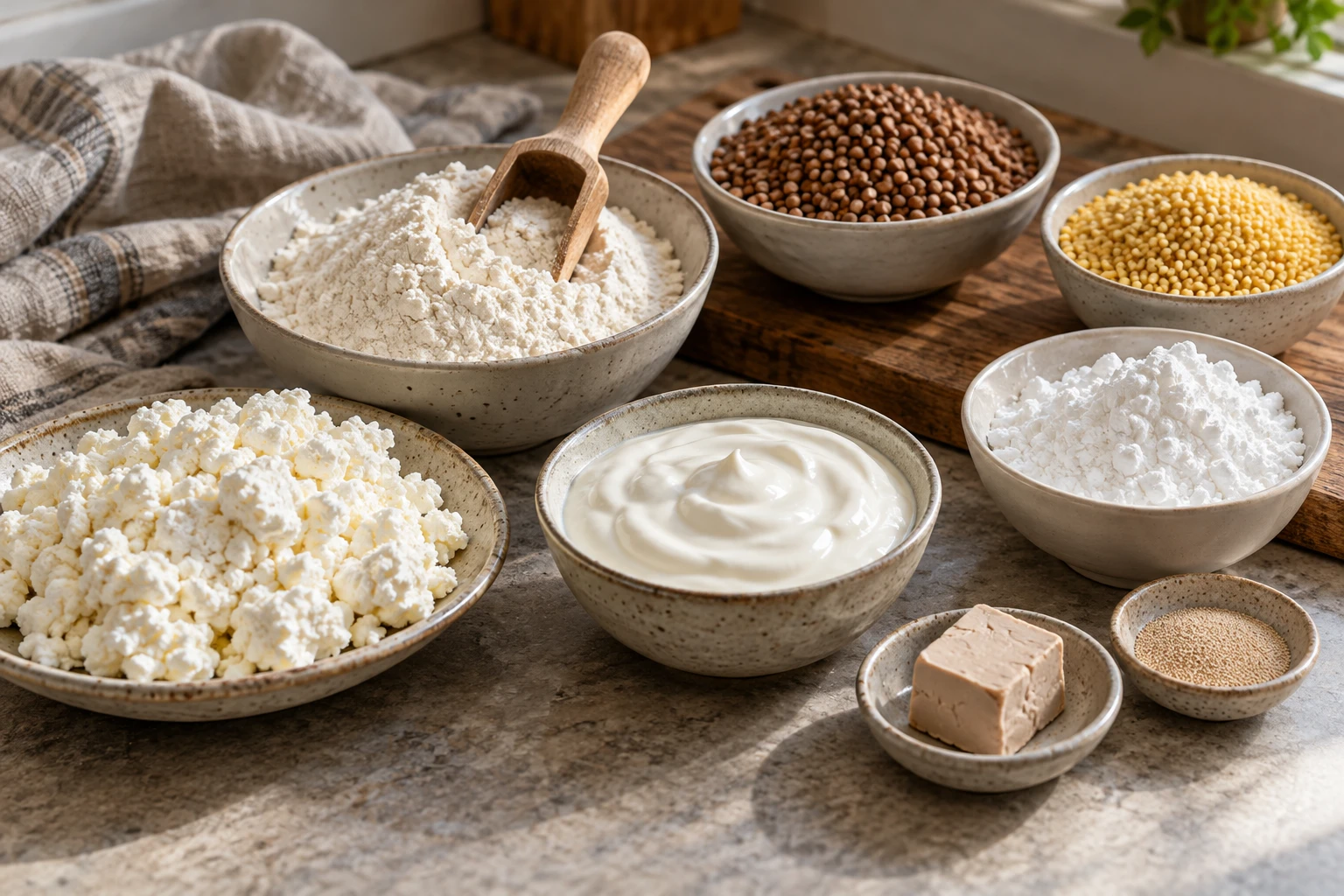
How to Use the Guide While Shopping
- First, identify the function of the ingredient: binding, leavening, fat, flavor, acidity, or filling structure.
- Read the ingredients and information about fat, water, added salt, or sugar. Do not choose solely based on the packaging photo.
- Check whether the mass refers to the whole product or the product after draining. The filling requires a specific mass of usable cheese, not whey.
- Compare units: mass in grams is not the same as volume in milliliters. A cup of flour does not weigh the same as a cup of sugar.
- When trying a new product, do a small test. One cooked pierogi is easier to adjust than dozens of finished pieces.
Download the PL–USA–UK–DE dictionary in CSV format. You can open it in a spreadsheet or save it on your phone. The article also contains links to actual product pages and labels.
Quick Name Table: What to Look for on the Shelf
| Polish Ingredient | USA | UK | Germany | Key Check |
|---|---|---|---|---|
| Cottage cheese for filling | Farmer cheese, dry curd cottage cheese | Polish twaróg, quark; check consistency | Speisequark, Quark | Moisture, salt, no flavor additives |
| Sour cream | Sour cream | Soured cream | Saure Sahne, Schmand | Fat and acidity depend on the product |
| Whipping cream | Heavy whipping cream | Whipping cream; double cream is richer | Schlagsahne | Does the manufacturer allow whipping? |
| Buttermilk | Cultured buttermilk | Buttermilk | Buttermilch | Natural version, without sugar and flavors |
| Kefir | Plain kefir | Natural/plain kefir | Kefir natur | Do not buy fruit-flavored for savory dough |
| All-purpose flour | All-purpose flour | Plain flour | Weizenmehl, e.g., Type 405 or 550 depending on the task | No baking powder in the ingredients |
| Bread flour | Bread flour | Strong white bread flour | Weizenmehl für Brot, often Type 550 | Protein and purpose, not just the number |
| Rye flour | Rye flour | Rye flour | Roggenmehl | Grinding degree and sourdough requirements |
| Potato starch | Potato starch | Potato starch; sometimes the name potato flour requires checking the ingredients | Kartoffelstärke; Kartoffelmehl requires checking the label | Pure potato starch |
| Cornstarch | Cornstarch | Cornflour | Maisstärke | Do not confuse with yellow cornmeal |
| Buckwheat groats | Buckwheat groats; roasted buckwheat/kasha for roasted | Buckwheat groats | Buchweizen, geröstet for roasted | Whole grain, not flour; roasted or unroasted |
| Hulled millet | Hulled millet | Millet | Hirse, geschält | Food product, not bird feed |
| Pearl barley | Pearl barley | Pearl barley | Perlgraupen, Gerstengraupen | Grain size and cooking time |
| Semolina | Semolina/farina depending on the recipe | Semolina | Weichweizengrieß or Hartweizengrieß | Soft/hard wheat and granulation |
| Fresh yeast | Fresh yeast, cake yeast | Fresh yeast | Frische Hefe | Do not convert mass 1:1 to dry |
| Instant yeast | Instant yeast | Easy bake, fast action yeast | Trockenhefe | Manufacturer's instructions and mixture composition |
| Baking powder | Baking powder | Baking powder | Backpulver | This is a different agent than baking soda |
| Baking soda | Baking soda | Bicarbonate of soda | Natron | Food product; not washing soda |
| Powdered sugar | Powdered/confectioners' sugar | Icing sugar | Puderzucker | Possible starch addition; icing sugar may have additional ingredients |
| Fermented cucumbers | Fermented cucumbers, sour pickles | Fermented cucumbers, Polish ogórki kiszone | Salzgurken, milchsauer vergoren | Fermentation and composition; dill pickles may be vinegar-based |
The table is a selection dictionary, not a declaration of identical composition. For less obvious products, enter the full name from the ingredients into the manufacturer's search engine. The difference between "groats" and "flour" or "starch" and "meal" can completely change a dish.
Cottage Cheese: The Key is the Amount of Water
For Russian pierogi, lazy pierogi, and cheese doughnuts, you need cheese whose consistency will yield the appropriate filling or dough. In the USA, a sensible starting point is farmer cheese. An example of Lifeway Farmer Cheese is cheese with bacterial cultures; the manufacturer lists the packaging as 16 oz, about 455 g. This does not mean that every product described as farmer cheese will have the same moisture content.
Cottage cheese with a lot of creamy liquid requires different handling than dry cottage cheese. Quark can be very smooth and moist. Ricotta is a different cheese; it can provide a tasty adaptation but will not automatically recreate the Polish filling. Cream cheese alters the fat content, flavor, and texture of the cheesecake. On your first attempt, use a recipe developed for the chosen cheese or weigh a small batch and assess the result.
Example: The recipe requires 500 g of drained cheese
Buy an appropriate supply and drain it in the refrigerator, on a clean sieve with the proper cloth or filter. Weigh only the drained product. Do not assume that a 500 g package will yield 500 g of finished cheese. Note the mass before and after, as well as the product name, to replicate the result next time. Do not compensate for very wet cheese with an arbitrary large amount of flour: lazy pierogi may turn out tough, and doughnuts may lose their delicacy.
Quark in Germany: Fat Percentage vs. Fat in Dry Matter
In Germany, you may encounter the designation “Fett i. Tr.”, meaning fat content in dry matter. Do not compare it directly with grams of fat per 100 g of product from the nutrition table. The difference between these designations is explained by the LAVES consumer protection office. In practice, compare the table per 100 g and the consistency, not just the high percentage on the front of the package.
Sour Cream and Sweet Cream: Two Different Functions
Sour cream and soured cream are good terms to search for a sour product for pasta with strawberries, cucumber salad, or sauce. For whipping, look for cream that the manufacturer clearly assigns this function. American half-and-half is not a substitute for whipping. British double cream is usually richer than typical Polish cream, so the result will be richer. Categories and uses are explained by U.S. Dairy.
In Germany, distinguish between Saure Sahne, Schmand, Crème fraîche, and Schlagsahne. They are not one universal category. Check acidity, fat, and flavor additives. A herb dip described as sour cream is not suitable for sweet cakes. For soup sauce, apply the tempering technique and recipe requirements; a product with a different composition may behave differently when heated.
If the goal is the flavor of sour cream, natural yogurt can be an adaptation for a cold addition, but it changes the fat and consistency. We do not present it as an equivalent substitute for every baked good, sauce, or cream. Be particularly cautious when changing an ingredient in a recipe where acidity reacts with a leavening agent.
Flour: Polish Type, German Number, and American Protein
The flour type number is related to the mineral content, not a simple indication of “how much gluten it has.” Similar numbers in different countries do not guarantee identical behavior. German categories and their purposes are presented by the manufacturer Dr. Oetker and the catalog Diamant.
All-purpose flour and plain flour are reasonable starting names for many Polish home applications, but specific brands differ in protein and absorption. Bread flour is intended for different uses than delicate cake flour. The manufacturer King Arthur Baking describes flour selection based on properties. When making pierogi, add liquid gradually and assess elasticity, rather than assuming that every white flour will absorb exactly the same amount.
Trap: Self-Raising or Self-Rising
This is flour with a leavening agent; depending on the market and product, it may also contain other additives. Do not buy it for pierogi or as an automatic equivalent of cake flour. Always check the ingredient list on the package. If the recipe calls for regular flour and precisely measured powder, a ready mix complicates maintaining proportions.
Simple Test Before Shaping
Prepare a small piece of dough, let it rest according to the recipe, roll it out, and shape one pierogi. Cook the sample. If the dough is too firm after resting, adjust the liquid in small portions; if it is loose, assess the filling and flour. Record the result. Do not compare the dough before resting with finished dough from a video, as time changes its behavior.
Potato Starch, Potato Flour, and Cornflour
In Silesian dumplings, it usually refers to potato starch. In the USA, look for potato starch. Potato flour may mean flour made from the whole potato and is not the same product. This is directly confirmed by Bob’s Red Mill. British terminology can be different: even with the name potato flour, read whether the ingredients actually indicate starch.
American cornstarch and British cornflour usually lead to corn starch. Yellow cornmeal, cornmeal, and polenta are different products. In Germany, general Speisestärke is not enough to determine the origin: for example, Gustin describes it as pure corn starch. If a Polish recipe requires potato starch, look for Kartoffelstärke and check the ingredients.
We do not provide a single conversion for all starches. They have different properties, and in dumplings, jelly, and sauces, they serve different roles. First, keep the type of starch from the recipe; treat the substitution as a separate culinary test. A photo of a white powder does not reliably identify its type.
Yeast: Weigh the Mass, Read the Instructions
Fresh yeast, active dry, and instant are different forms of the product. Do not substitute fresh for dry gram for gram. In the packaging system described by Dr. Oetker, 7 g of dry yeast is sufficient for up to 500 g of flour, while a 42 g cube of fresh yeast is for 1 kg of flour. This results in a rough comparison of 7 g of dry to 21 g of fresh for this application. Rich, sweet dough and long fermentation may require a different recipe.
Do not convert “one packet” between countries without checking the weight. Techniques for adding and differences between active dry/instant are discussed in the King Arthur Baking guide. Stick to the instructions for the specific product, the temperature of the liquid, and the state of the dough. More yeast will not replace rising time or fix overheated dough.
Groats and Grains: Choose the State of the Product
For buckwheat, look for buckwheat groats or Buchweizen. Roasted has different flavor characteristics than unroasted; the terms roasted or geröstet help distinguish them. An example of a roasted name is shown by the Polish producer GRINO. The word kasha in an American store requires checking the contents of the package. Do not buy buckwheat flour when you need whole groats.
Hulled millet is hulled millet, e.g., hulled millet. Barley groats can have different grain sizes and degrees of refinement, so do not transfer cooking times from the packaging of another product. For semolina, distinguish between fine wheat semolina and coarser durum semolina. Not every “semolina” will give the same structure to a dessert.
Buckwheat and millet as raw materials do not replace information about contamination during production. A person needing a strict gluten-free diet should choose appropriately labeled products and check the label. Barley, wheat, and rye do not become gluten-free by rinsing or prolonged cooking.
Butter, Sugar, Pickles, and Roots
For recipes with butter, choose a product with the appropriate composition, not just any spread. Butter-oil blends can change the dough. Unsalted butter makes it easier to control salt if the Polish recipe does not account for salted butter. For cream cheese and other salted products, also check the balance of the entire dish.
Powdered sugar is powdered sugar, confectioners’ sugar, icing sugar, or Puderzucker. Caster sugar is fine granulated sugar, not powdered. Brown sugar may have a different flavor and moisture than white; do not treat the substitution as neutral in every cake. Vanilla sugar, vanilla sugar, and vanilla extract are not portions of the same strength.
Cucumbers described as dill pickles do not have to be fermented: the name may refer to dill, and the product may contain vinegar. For Polish cucumber soup or salad, read the ingredients and fermentation description. Sauerkraut may also have wine, sugar, or spice additives. Taste before salting the entire filling.
Parsley root is parsley root or Petersilienwurzel; parsnip is parsnip/Pastinake. They have a similar appearance but not identical flavor. Celeriac is celeriac/Knollensellerie, and stalk celery is Staudensellerie. If you are adapting broth to available vegetables, note the change instead of expecting the same aroma.
Four Practical Shopping Sets
Russian Pierogi in the USA
Look for all-purpose flour without leavening, potatoes suitable for boiling, and farmer cheese without additives. Check the moisture of the cheese. Prepare the filling, chill it, cook a test pierogi, and only then shape the entire batch. If you only have wet cottage cheese, measuring it after draining is more important than a similar name.
Cheesecake in the UK
The easiest way to achieve the known structure may be Polish twaróg from a Polish store. If you choose quark or cream cheese, use a recipe that accounts for that product. Do not simultaneously replace cheese, eggs, fat, and flour: it will not be clear which change is responsible for the effect.
Silesian Dumplings in Germany
Find Kartoffelstärke and confirm the origin of the starch in the ingredients. General Speisestärke may turn out to be corn-based. Choose the right potatoes, steam them according to the recipe, and make one test dumpling. Adding increasing amounts of random powder usually moves away from the intended consistency.
Yeast Cake in Any of the Three Countries
Weigh the flour, check the type of yeast and its actual weight. Record the temperature of the ingredients and observe the rising. If the instructions allow for a longer time, do not compensate with hot liquid. Changing flour and yeast at the same time may require more than a mechanical conversion of grams.
How to Read an Actual Label
| Field | What to Record | Example Question |
|---|---|---|
| Full Name | Not just the brand | Potato starch or potato flour? |
| Ingredients | Raw material, additives, and allergens | Pure starch or a mix? |
| Table per 100 g | Fat, protein, salt, sugars | Is the cheese similarly fatty and salty? |
| Mass | Net and after draining | How much filling will I actually get? |
| Instructions | Purpose and preparation | Can the cream be whipped? |
| Storage | Temperature and shelf life after opening | Can I use an opened package in three days? |
For visual comparison, use photos on manufacturers' websites: farmer cheese packaging, Gustin and its composition, types of Diamant flours. These are examples of category identification, not advertising or a guarantee of availability. Do not use an AI-generated photo of packaging as proof of product composition.
Units Without Guessing
In the kitchen, it is convenient to round 1 oz of mass to about 28.35 g, and 1 lb to about 453.6 g; 16 oz is 1 lb. Definitions of units and conversions are published by NIST. Fluid ounce is a unit of volume, not the same as ounce of mass. For cups and glasses, the recipe should specify capacity. It is safest for repeatability to weigh dry ingredients.
Example calculation: you need 1 kg of cheese, and the package has 455 g before draining. Two packages total 910 g, so they will not be enough even without water loss. Buy three or appropriately reduce the recipe. This is simple arithmetic but prevents accidentally diluting the mass with other products.
FAQ
Should the substitute always be 1:1?
No. Most often, you can start with a comparable mass of a product with similar properties, but moisture, fat, and leavening may require changing the recipe. The difference is particularly significant with starch, yeast, and cheeses.
Is German Type 405 the same as Polish cake flour?
It may be a practical candidate for some applications, but it is not a promise of an identical product. Compare purpose, composition, and effect in a small test.
Is every quark suitable for Polish cheesecake?
Not every one in the same recipe. Check moisture and fat; choose a recipe that anticipates the specific type of cheese.
Do all white starches look similar?
So similarly that appearance alone is not enough for identification. Keep the original label, even after transferring to a jar.
Where to start if I don't know the product name?
Take the Polish list and show the name from the guide along with its function in the recipe. Ask about the ingredients, rather than just the name. If in doubt, choose a recipe written for the local ingredient.
Sources and Related Guides
Source links are placed with the relevant product groups. Manufacturer materials confirm the characteristics of their own products, not the entire market. Supplement your own shopping notebook with the name, weight, label photo, and dish result.
Comments (0)
No comments yet. Be the first!