
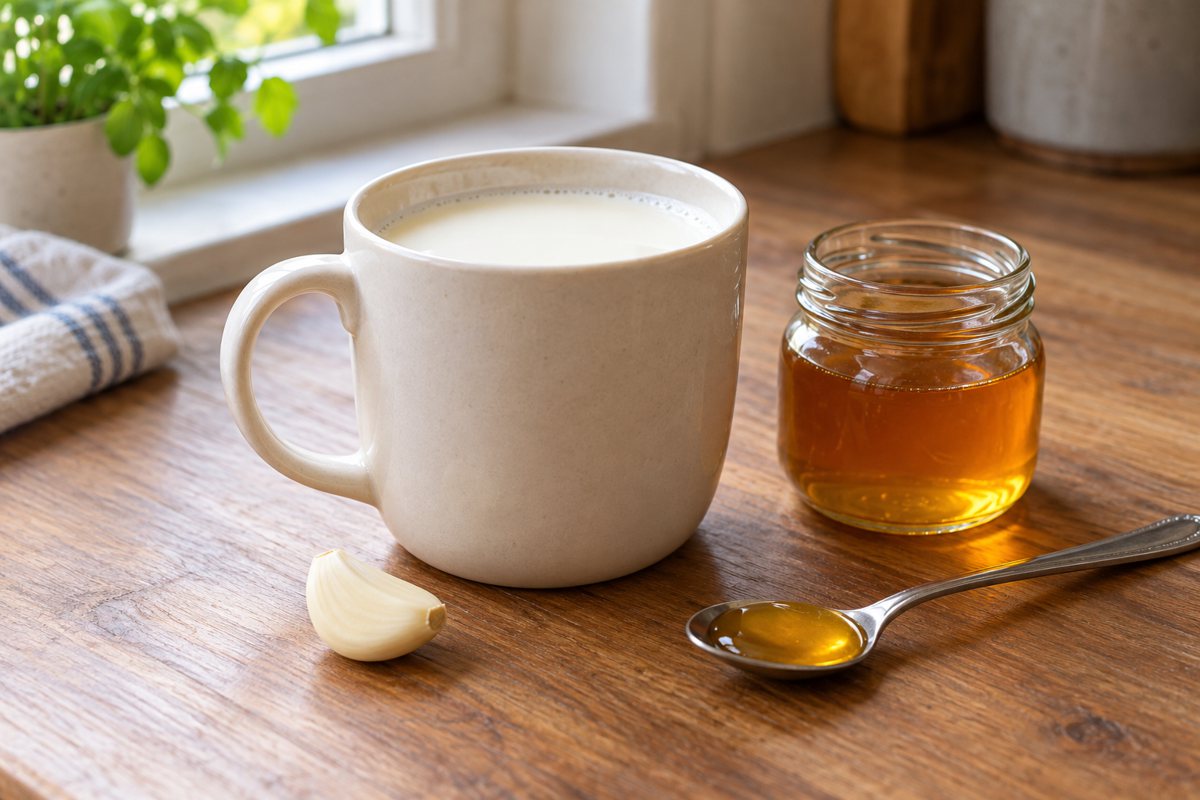
Warm milk with garlic and honey is associated by many with an evening under a blanket when a scratchy throat begins. You can keep this home remedy if you like the taste and tolerate the ingredients well. However, it is important to separate the enjoyment of drinking the beverage from treating an illness: there is no basis to present this mixture as a cure for an infection.
- Honey may relieve cough in some individuals. Evidence is limited and pertains to symptom relief, not curing infections.
- Research on garlic does not support claims that it prevents colds or shortens illness duration.
- Honey should not be given to children under one year of age.
- In the case of severe symptoms, the homemade drink should not delay seeking help.
Source: NICE on honey and cough, NCCIH on colds and garlic, NHS on infant botulism.
Three Ingredients and Three Different Roles
In the kitchen, milk is simply the base of the drink, garlic gives it a sharp flavor, and honey adds sweetness. One should not transfer research results about one ingredient to the finished mixture. The information that honey may help with cough does not prove that milk with garlic and honey works more effectively than honey alone or another well-tolerated drink.
| Ingredient | What Can Be Said | What Should Not Be Promised |
|---|---|---|
| Honey | NICE describes limited evidence of possible improvement in acute cough symptoms. The studies discussed had a short observation period. | That it removes the cause of the infection or certainly shortens the duration of the illness. |
| Garlic | NCCIH indicates a lack of good studies on preventing colds and alleviating their symptoms. | That it is a home antibiotic or can replace prescribed treatment. |
| Milk | In this recipe, it is a chosen food ingredient if you tolerate it. | That simply adding milk gives the mixture proven therapeutic effects. |
This distinction arises from the scope of available data, not from a comparative study of our recipe. Details: NICE NG120 and NCCIH information review.
Mild Version for One Cup
The following amounts are a culinary suggestion for an adult who tolerates all ingredients. They do not constitute a therapeutic dose or a recommendation for daily treatment.
- 200–250 ml of pasteurized milk, as you usually drink;
- half a small clove of garlic to start; a stronger flavor can be achieved with a whole small clove;
- about 1 teaspoon of honey, to taste.
Butter, additional sugar, and alcohol are not needed. If garlic irritates, omit it. There is no need to endure a burning sensation in the throat for the drink to "work." Oral garlic can cause nausea or stomach pain, and some individuals may have allergic reactions: NCCIH information on garlic safety.
Preparation Without Scalding the Mouth
- Prepare the Garlic
Peel a small clove. For the first cup, use half, lightly crushed. You can leave it in a larger piece if you prefer a milder drink than one made with garlic pressed through a garlic press.
- Heat the Milk
Heat the milk in a small saucepan over low heat, stirring. Add the garlic and let it sit for a moment to combine the flavors. Do not allow it to burn. Prolonged cooking is not necessary to prepare a drink with pasteurized milk.
- Cool and Add Honey
Pour into a cup, removing the piece of garlic if necessary. Wait until the milk is pleasantly warm, not scalding, and stir in the honey. There is no need to set a specific "magical" temperature at which the drink suddenly becomes a remedy.
- Drink According to Tolerance
Try a small sip. If the taste or smell bothers you, choose another drink. Do not force a child to drink garlic. Do not give hot drinks to small children; NHS warns about the risks associated with hot drinks.
Honey Not for Infants
Do not give honey to a child under 12 months, even as an ingredient in this drink. It may contain spores of bacteria that cause infant botulism. Do not consider homemade heating of milk with honey as a way to bypass this recommendation. Source: NHS, botulism.
A serving for an adult is not automatically a serving for a child. If in doubt about a sick child, consult a pediatrician or pharmacist instead of increasing the amount of the homemade mixture. Simply reaching the age of one does not mean that garlic and milk are needed to alleviate a cough.
When to Skip Garlic
If it causes stomach pain, nausea, or irritation, do not increase the amount. Individuals with a diagnosed allergy to any ingredient should avoid it. Greater sharpness of the drink does not mean greater benefit. NCCIH lists gastrointestinal discomfort and allergic reactions among the possible side effects of garlic.
Separate considerations apply to supplements and large amounts taken as treatment. Garlic preparations may increase the risk of bleeding, especially when combined with medications affecting coagulation. If you are taking such medications, aspirin, or are scheduled for surgery, discuss the planned treatment with your doctor or pharmacist. Do not stop taking medications because of a homemade drink. This warning particularly applies to preparations and therapeutic use; it does not prove that a single culinary portion has the same effect. NCCIH: garlic and safety.
What Helps Get Through a Cold
Rest and regular fluid intake are a more practical basis for home care than searching for a mandatory mixture. If you do not feel like drinking milk, you do not have to. Choose pain relievers or symptom treatments according to the leaflet and pharmacist's advice; check that two products do not contain the same active substance. NHS describes how to manage a cold and caution when combining products.
Colds are caused by viruses. Antibiotics do not speed up the resolution of a typical viral cold, and garlic is not a substitute for them. If a doctor diagnoses another illness and recommends treatment, follow their advice. NHS explanation.
Symptoms That Require Immediate Attention
Severe shortness of breath, inability to speak a full sentence, cyanosis, or sudden confusion require urgent medical assistance. Use the emergency number appropriate for your location. Do not try to drink the beverage first and wait to see if it passes. NHS: alarming symptoms with shortness of breath.
Contact a doctor if fever persists for more than 3 days, symptoms worsen, there is no improvement after about 10 days, or cough lasts more than 3 weeks. In cases of reduced immunity, chronic illness, or concerning symptoms in a child, earlier evaluation may be necessary. These thresholds are not a recommendation to wait despite worsening. NHS: when to seek advice.
Frequently Asked Questions
Do I have to drink milk with garlic to get better?
No. It is one of the home traditions, not a mandatory treatment. If the drink does not suit you, choose well-tolerated fluids and rest. A lack of desire for garlic does not hinder recovery.
Should honey be added to boiling milk?
There is no need. In this variant, we add it after cooling to make the drink suitable for consumption and to easily assess the taste. We do not attribute this action with therapeutic effects nor set a temperature threshold that guarantees effectiveness.
Can I skip milk or garlic?
Yes. There is no need to maintain all ingredients if you do not tolerate them well. Data on possible relief from honey do not require milk and garlic. Honey is still not suitable for children under one year.
Does a daily cup prevent infections?
There is no basis to promise such an effect. We do not set a therapeutic frequency or duration of "treatment." The homemade drink can be treated as food, not as a guarantee of immunity.
Does this drink cure the flu, COVID-19, or pneumonia?
We do not present it as a treatment for these diseases. If a serious infection is suspected or symptoms worsen, proper medical evaluation is needed. The taste known from childhood does not replace a disease diagnosis.
Sources
| Source | Type | Status / Credibility |
|---|---|---|
| NICE NG120: honey and acute cough | Guidelines and evidence discussion | Limited data on symptom relief; not a study of our mixture. |
| NCCIH: cold, flu, and complementary methods | Public health institution | Insufficient evidence for garlic's effectiveness in colds. |
| NCCIH: garlic safety | Public health institution | Side effects, supplements, interactions. |
| NHS: botulism | Public health service | Prohibition on giving honey to infants. |
| NHS: cold | Public health service | Home care and indications for advice. |
| NHS: shortness of breath | Public health service | Symptoms requiring urgent help. |
As of October 27, 2026. Educational material. Culinary suggestion does not replace diagnosis or individual treatment.
Comments (0)
No comments yet. Be the first!